Season 1 · Episode 005 ·
The Battle of Saraighat (1671)
The Battle of Saraighat, 1671: how the Ahoms turned back a Mughal fleet on the Brahmaputra at Guwahati.
 Play the video on YouTube
The video plays from YouTube when you press play.
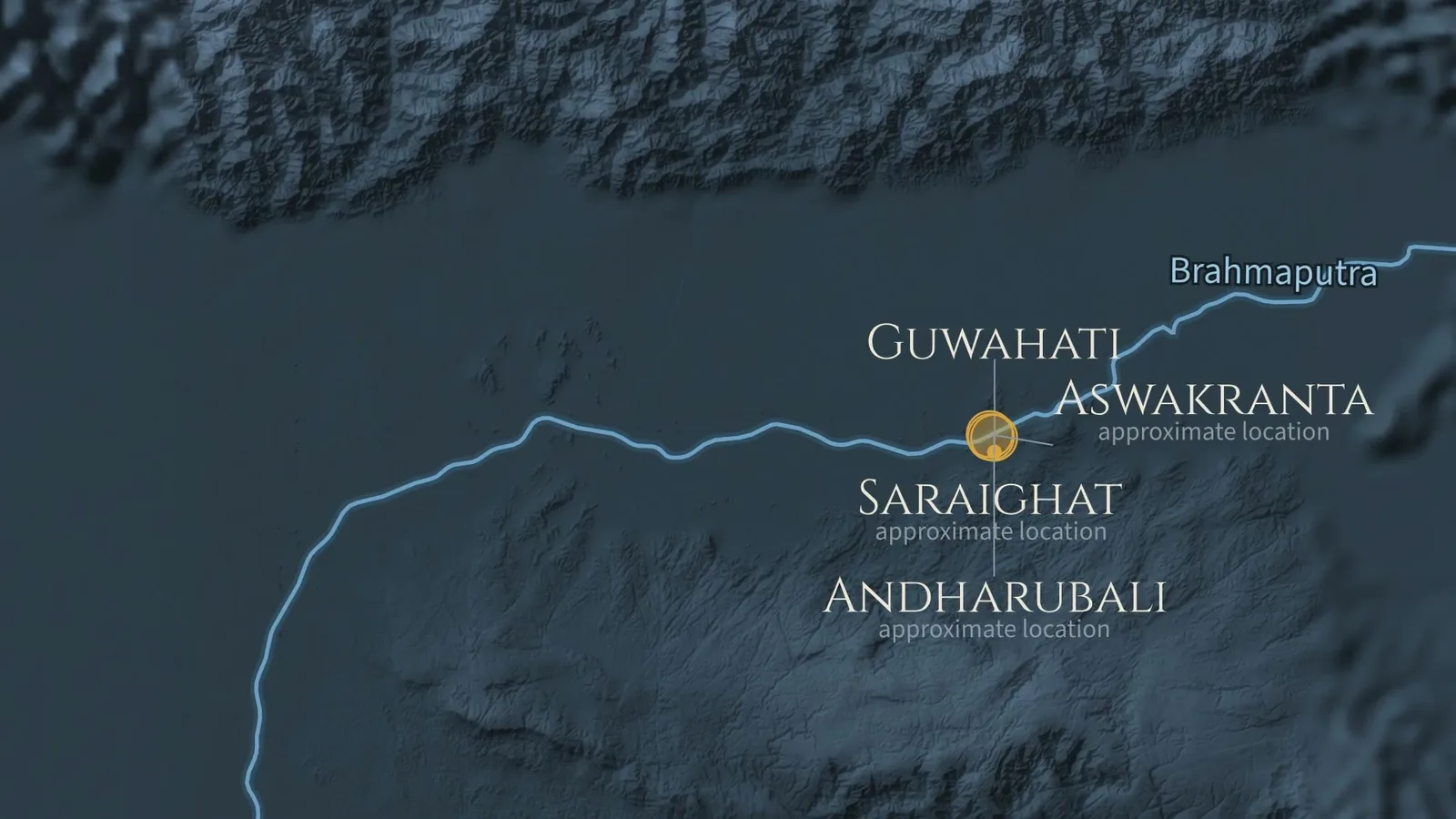
In 1671 the Brahmaputra at Guwahati was the scene of the Battle of Saraighat, fought on the river between the Ahom kingdom of Assam and a Mughal fleet1. Strictly, Saraighat meant the small village of Sarai at Amingaon, opposite Pandu, but in those days the name was used loosely for Guwahati and its surroundings2.
The road to the battle
In December 1667 the emperor Aurangzeb appointed Raja Ram Singh of Amber to retake Guwahati3. Ram Singh reached Rangamati, on the Assam frontier, in February 16694. Before the Battle of Alaboi that year, an Ahom war council had decided that their strength lay in fighting on the water, and that they should draw the Mughals into a battle on the Brahmaputra5.
After peace talks failed, Ram Singh resolved to settle the war by attacking again6. According to the chronicles, when Aurangzeb rebuked him, he replied that the Assamese had built an impenetrable wall of defence on both banks, so only one naval fight was possible7. Unable to take Guwahati by land, he turned to his fleet as his last resort8. His own fleet numbered about forty war-vessels, with Europeans among its crews9,10, and Munawwar Khan brought reinforcements, including ships11. Yet the historian Jadunath Sarkar wrote that, unlike the time of Mir Jumla’s invasion, the mastery of the water now belonged to the Ahoms12.
The plan at Andharubali
A Mughal envoy, Panditrai, had seen an opening at Andharubali and reported it to Ram Singh13. Andharubali was the sandbank shore of Guwahati between Itakhuli and the foot of Kamakhya Hill14. Ram Singh planned to carry his men and horses there by boat and land them on the open shore to break into Guwahati15. Before the attack came, the Ahoms walled that shore16.
The Ahom fleet falls back
As the Mughal fleet advanced up the river, the Ahom fleet fell back17. Their commander, Lachit Borphukan, was ill18. Ahom morale broke, and some crews loaded their boats to retreat19. Even the boats of the prime minister and of Lachit himself were loaded, ready to leave20. Ill as he was, Lachit followed the Mughal advance, receiving reports every few minutes21.
Lachit’s charge
Lachit had himself taken into a war-boat and charged the Mughal fleet with seven boats22, and he sent messengers ordering all his land and naval forces to attack23. The chronicles say that when his own oarsmen began rowing away from the fight, he struck four of them with the flat of his sword and threw them into the river, and let them be rescued when their comrades pleaded24.
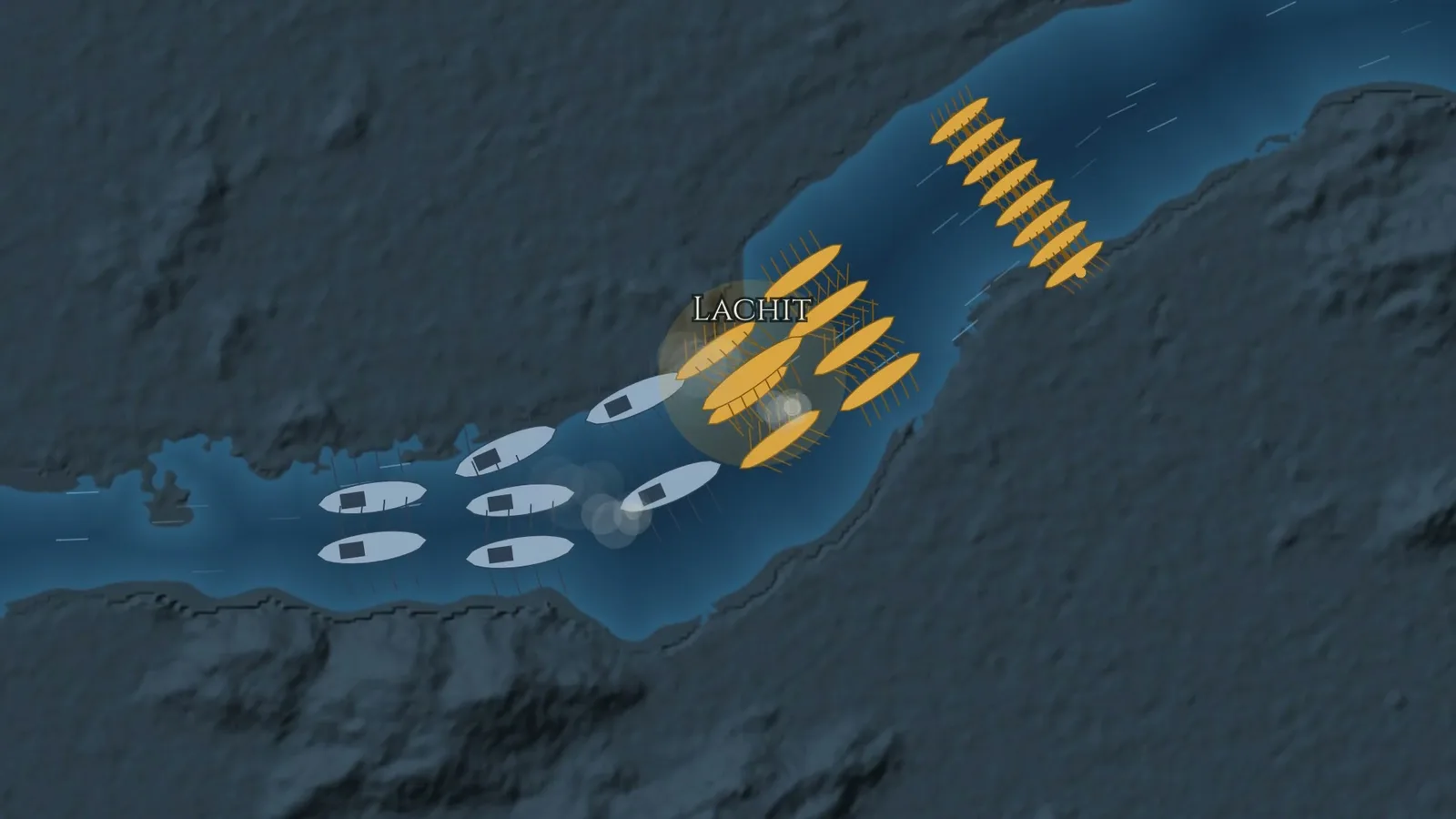
His charge restored his army’s morale, and Ahom boats from both banks joined the attack25. Guns and archers fired from both banks as well as from the boats26, and the Ahoms massed so many war-boats that they bridged the river from bank to bank27. The fighting filled the river between Kamakhya and Itakhuli on the south bank and Aswakranta on the north28.
The Mughal fleet breaks
The Ahom boats fell on the Mughal fleet and threw it into confusion29. A Mughal naval commander was killed in the fighting30. Sources disagree on his name; the historian S. K. Bhuyan calls him Raship Khan, nephew of the admiral Munawwar Khan, while Padmeswar Gogoi, following an Assamese chronicle, names the commandant Sharip Khan31. In Bhuyan’s account he was shot while smoking his hookah on his boat, with his back to the Assamese32.
Many Mughal boats sank with their men, horses and war materials, and the river was littered with boats and drowning men33. The surviving boats fled downstream34, and the Ahoms chased them as far as Pandu, about three miles away35. Saraighat was a decisive Ahom victory36.
After the battle
Lachit would not let his men attack the retreating army, reminding them of Alaboi37. Ram Singh retreated downriver to Rangamati38. As he left, he said at Hajo that the Ahom commander’s fortifications gave him no loophole for attack39. According to the chronicles, he also praised the Assamese soldiers as expert at rowing, archery, digging trenches, and handling guns and cannon40. He never advanced into Assam again, and he left the frontier in 167641.
The victory did not keep Guwahati for good. In 1679 the Ahom Barphukan handed it back to the Mughals42.
What is uncertain
- The month. According to the historian Padmeswar Gogoi, the battle was fought in the middle of March 167143. S. K. Bhuyan dates the start of Ram Singh’s retreat to about 5 April, which would put the battle in early April. This page says only “1671”.
- The commander who was killed. Sources disagree on his name; see above31.
- The size of the fleets. Ram Singh’s own fleet was about forty war-vessels, but Munawwar Khan’s ships made it larger9,11. None of the sources we read gives the full size of either fleet.
On the map
Pictures
Virginia Museum of Fine Arts · public domain
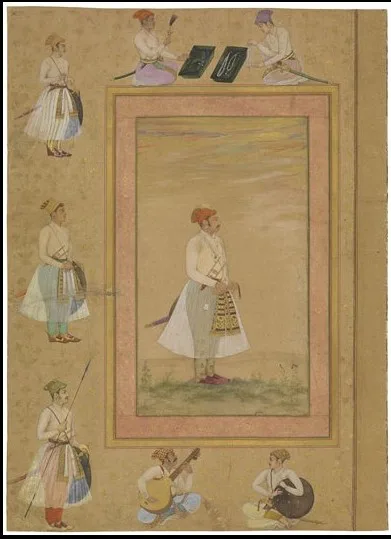
Ram Singh of Amber, page from the Late Shah Jahan Album, c. 1650–58, Virginia Museum of Fine Arts (Nasli and Alice Heeramaneck Collection, Gift of Paul Mellon, 68.8.64). Public domain, via Wikimedia Commons: https://commons.wikimedia.org/wiki/File:Ram_Singh_of_Amber.jpg
Timeline
- December 1667 Aurangzeb sends Ram Singh to retake Guwahati
- February 1669 Ram Singh reaches the frontier at Rangamati
- 1671 Battle of Saraighat
- 1671 Ram Singh retreats to Rangamati
- 1676 Ram Singh leaves the frontier
- 1679 Guwahati handed back to the Mughals
Narration
Read what the video says
1671. A Mughal fleet sails up the Brahmaputra to break into Guwahati. The Ahom navy is falling back.
Raja Ram Singh had failed to take Guwahati by land. The fleet was his last resort.
He meant to land his cavalry on an open shore at Andharubali. The Ahoms walled it first.
But their commander, Lachit Borphukan, lay ill, and some crews were loading boats to flee.
Fever and all, Lachit had himself taken into a war-boat and charged with seven boats.
His army rallied. Guns and archers fired from both banks, and Ahom boats bridged the river.
The Mughal fleet broke. A commander was killed, and boats sank with men and horses.
Ram Singh retreated to Rangamati and never advanced again. Guwahati stayed Ahom until 1679.
Notes
Each number in the text leads here: the fact, how well it is supported, and where it is written. How we grade the evidence.
- The Battle of Saraighat was fought on the Brahmaputra at Guwahati in 1671. Verified: two independent sources agree Gogoi (1968), p. 742; Bhuyan (1947), p. 86 (approx.); Gait (1906), p. 150 (approx.); Sarkar (1928), p. 190 (approx.) ↩
- 'Saraighat' strictly meant the small village of Sarai at Amingaon, opposite Pandu, but the name was used loosely for Guwahati and its surroundings. Supported: one solid source Bhuyan (1947), p. 83 (approx.); p. 84 (approx.) ↩
- Aurangzeb appointed Raja Ram Singh of Amber in December 1667 to retake Guwahati. Verified: two independent sources agree Sarkar (1928), p. 187 (approx.); Gait (1906), p. 148 (approx.) ↩
- Ram Singh reached Rangamati, on the Assam frontier, in February 1669. Verified: two independent sources agree Gait (1906), p. 148 (approx.); Sarkar (1928), p. 187 (approx.) ↩
- Before Alaboi, an Ahom war council decided that their strength lay in fighting on the water, and that they should draw the Mughals into a battle on the Brahmaputra. Supported: one solid source Bhuyan (1947), p. 63 (approx.) ↩
- After peace talks failed, Ram Singh resolved to settle the war by attacking again. Verified: two independent sources agree Bhuyan (1947), p. 78 (approx.); Sarkar (1928), p. 189 (approx.); Gait (1906), p. 149 (approx.) ↩
- Answering a rebuke from Aurangzeb, Ram Singh replied that the Assamese had built an impenetrable wall of defence on both banks, so only one naval fight was possible. Supported: one solid source Bhuyan (1947), p. 77 (approx.) ↩
- Unable to take Guwahati by land, Ram Singh relied on his fleet as his last resort. Verified: two independent sources agree Gogoi (1968), p. 739; Sarkar (1928), p. 189 (approx.) ↩
- Ram Singh's own fleet numbered about forty war-vessels. Supported: one solid source Sarkar (1928), p. 188 (approx.); Gogoi (1968), p. 739 ↩
- Europeans ('Firinghees') served in Ram Singh's fleet. Verified: two independent sources agree Bhuyan (1947), p. 78 (approx.); Gogoi (1968), p. 739 ↩
- Munawwar Khan brought reinforcements, including ships, to Ram Singh. Verified: two independent sources agree Sarkar (1928), p. 189 (approx.); Gogoi (1968), p. 739 ↩
- By this stage of the war, mastery of the river belonged to the Ahoms, unlike during Mir Jumla's invasion. Supported: one solid source Sarkar (1928), p. 188 (approx.) ↩
- A Mughal envoy, Panditrai, had seen the opening at Andharubali and reported it to Ram Singh. Verified: two independent sources agree Bhuyan (1947), p. 73 (approx.); Gogoi (1968), p. 740 ↩
- Andharubali was the sandbank shore of Guwahati between Itakhuli and the foot of Kamakhya Hill. Verified: two independent sources agree Bhuyan (1947), p. 73 (approx.); Gogoi (1968), p. 740 ↩
- Ram Singh planned to carry his men and horses by boat and land them on the open shore at Andharubali, to break into Guwahati. Verified: two independent sources agree Bhuyan (1947), p. 74 (approx.); Gogoi (1968), p. 740 ↩
- Before the attack came, the Ahoms walled the open shore at Andharubali. Verified: two independent sources agree Bhuyan (1947), p. 79 (approx.); Gogoi (1968), p. 740 ↩
- As the Mughal fleet advanced up the river, the Ahom fleet fell back. Verified: two independent sources agree Gogoi (1968), p. 740; p. 741; Bhuyan (1947), p. 80 (approx.); Gait (1906), p. 150 (approx.) ↩
- Lachit Borphukan was ill when the Mughal fleet attacked. Verified: two independent sources agree Bhuyan (1947), p. 78 (approx.); Gogoi (1968), p. 740 ↩
- Ahom morale broke, and some crews loaded their boats to retreat. Verified: two independent sources agree Bhuyan (1947), p. 79 (approx.); Gogoi (1968), p. 741 ↩
- Even the boats of the prime minister and of Lachit were loaded, ready to leave. Supported: one solid source Bhuyan (1947), p. 79 (approx.) ↩
- Though ill, Lachit followed the Mughal advance, receiving reports every few minutes. Verified: two independent sources agree Bhuyan (1947), p. 81 (approx.); Gogoi (1968), p. 740-741 ↩
- Lachit had himself taken into a war-boat and charged the Mughal fleet with seven boats. Verified: two independent sources agree Bhuyan (1947), p. 81 (approx.); p. 82 (approx.); Gogoi (1968), p. 741; Gait (1906), p. 150 (approx.) ↩
- Lachit sent messengers ordering all his land and naval forces to attack. Supported: one solid source Gogoi (1968), p. 741 ↩
- When his own oarsmen began rowing away from the fight, Lachit struck four of them with the flat of his sword and threw them into the river; he let them be rescued when their comrades pleaded. Supported: one solid source Bhuyan (1947), p. 82 (approx.) ↩
- Lachit's charge restored his army's morale, and Ahom boats from both banks joined the attack. Verified: two independent sources agree Gogoi (1968), p. 741; Bhuyan (1947), p. 82 (approx.) ↩
- Ahom guns and archers fired from both banks as well as from the boats. Verified: two independent sources agree Bhuyan (1947), p. 82 (approx.); Gogoi (1968), p. 742 ↩
- The Ahoms massed so many war-boats that they bridged the Brahmaputra from bank to bank. Verified: two independent sources agree Bhuyan (1947), p. 83 (approx.); Gogoi (1968), p. 741 ↩
- The fighting filled the river between Kamakhya and Itakhuli on the south bank and Aswakranta on the north. Verified: two independent sources agree Bhuyan (1947), p. 83 (approx.); Gogoi (1968), p. 740; p. 742 ↩
- The Ahom boats fell on the Mughal fleet and threw it into confusion. Verified: two independent sources agree Bhuyan (1947), p. 83 (approx.); Gogoi (1968), p. 742; Gait (1906), p. 150 (approx.) ↩
- A Mughal naval commander was killed in the fighting. Verified: two independent sources agree Bhuyan (1947), p. 82 (approx.); Gogoi (1968), p. 742 ↩
- The Mughal commander killed was Raship Khan, nephew of the admiral Munawwar Khan. Disputed: sources disagree Bhuyan (1947), p. 77 (approx.); Gogoi (1968), p. 742 ↩
- He was shot while smoking his hookah on his boat, with his back to the Assamese. Supported: one solid source Bhuyan (1947), p. 82 (approx.) ↩
- Many Mughal boats sank with their men, horses and war materials, and the river was littered with boats and drowning men. Verified: two independent sources agree Gogoi (1968), p. 742; Bhuyan (1947), p. 83 (approx.) ↩
- The surviving Mughal boats fled downstream. Verified: two independent sources agree Gogoi (1968), p. 742; Bhuyan (1947), p. 83 (approx.) ↩
- The Ahoms chased them as far as Pandu, about three miles downstream. Supported: one solid source Bhuyan (1947), p. 83 (approx.) ↩
- Saraighat was a decisive Ahom victory. Verified: two independent sources agree Bhuyan (1947), p. 83 (approx.); Gogoi (1968), p. 742; Gait (1906), p. 150 (approx.) ↩
- Lachit would not let his men attack the retreating army, reminding them of Alaboi. Verified: two independent sources agree Bhuyan (1947), p. 86 (approx.); Gogoi (1968), p. 743 ↩
- After the battle Ram Singh retreated downriver to Rangamati, on the Assam frontier. Verified: two independent sources agree Gait (1906), p. 150 (approx.); Sarkar (1928), p. 190 (approx.) ↩
- Leaving, Ram Singh said at Hajo that the Ahom commander's fortifications gave him no loophole for attack. Verified: two independent sources agree Bhuyan (1947), p. 86 (approx.); Gogoi (1968), p. 743 ↩
- Ram Singh praised the Assamese soldiers as expert at rowing, archery, digging trenches, and handling guns and cannon. Supported: one solid source Bhuyan (1947), p. 83 (approx.) ↩
- Ram Singh never advanced into Assam again; he left the frontier in 1676. Verified: two independent sources agree Sarkar (1928), p. 190 (approx.); Bhuyan (1947), p. 87 (approx.); Gogoi (1968), p. 743 ↩
- In 1679 the Ahom Barphukan handed Guwahati back to the Mughals. Verified: two independent sources agree Gait (1906), p. 157 (approx.); Sarkar (1928), p. 190 (approx.) ↩
- The battle was fought in the middle of March 1671. Disputed: sources disagree Gogoi (1968), p. 742; Bhuyan (1947), p. 85 (approx.); p. 86 (approx.) ↩
Sources
How this video was made
Maps show places only; no borders are drawn. Map animations and 3D scenes are illustrative reconstructions: boat numbers, formations and movements are not from sources. Modern photographs are labelled as modern.
- Terrain: SRTM and GMTED2010 courtesy of the U.S. Geological Survey; ETOPO1, NOAA.
- Rivers and coastlines: Natural Earth (public domain).
- Narration: synthetic voice made with the open Kokoro-82M text-to-speech model.
- Music and sound effects: generated in code for this channel.
- 3D scenes: rendered with Blender (free, open source).
More from Season 1
 Season 1 · Episode 001
Battle of Alaboi (1669)
The Battle of Alaboi, 1669: a heavy Ahom defeat two years before Saraighat, and the lesson Lachit Borphukan drew from it.
 Season 1 · Episode 002
Lachit Borphukan — The Man Behind Saraighat
Lachit Borphukan: the Ahom commander who rose from his sickbed to lead the attack at Saraighat in 1671.
 Season 1 · Episode 003
Battle of Kohima (1944)
The Battle of Kohima, 1944: how Japan's offensive into India was turned back in the Naga Hills.
 Season 1 · Episode 004
The Ahom Kingdom — The Dynasty That Resisted the Mughals
The Ahom Kingdom: the dynasty that ruled in Assam for about 600 years, from Sukaphaa to the Treaty of Yandabo.
 Season 1 · Episode 006
Sukapha — The Prince Who Founded the Ahom Kingdom
Sukaphaa: the Tai prince who, the chronicles say, crossed the Patkai hills in 1228 and founded the Ahom kingdom.